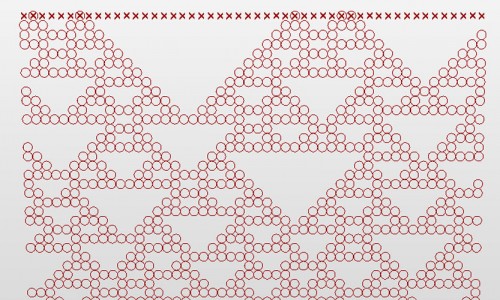

A Cellular automaton is a special kind of universe: space is divided into a finite number of cells, while time advances in time ‘hops’(t=0,1,2,3,…)
Each cell has a state ( for ex.: ‘Dead’, ‘Alive’, ‘True’, ‘False’, ‘Red’, ‘Blue’). A cell represents a Finite State Machine.
The cells are connected together. A group of connected cells is called a neighborhood/cluster. The state of the cell is affected by the states of it’s neighbors.
In the common scenario when time changes(for ex. t=1) each cell changes it’s current state in parallel to the other cells in the automaton.
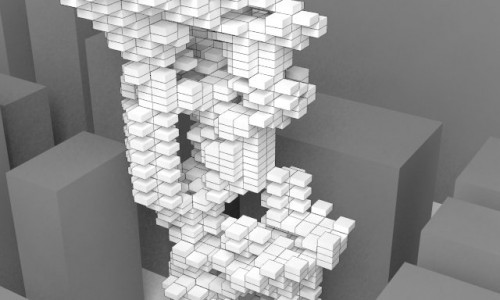
A cellular automaton could exist in multiple dimensions: 1-D, 2-D, 3-D, …
One could think of a cellular automaton as a multi-agent system. Each cell represents an agent. Global emerging behavior could be observed in result of local interactions between cells.
More about Cellular automata:
http://en.wikipedia.org/wiki/Cellular_automaton
http://mathworld.wolfram.com/CellularAutomaton.html

Life-like cellular automata are composed of “living” cells. A living cell has two possible states: Dead or Alive.
By default a cell dies except in these cases:
where N and K are integers (for ex. N=2, K=3)
Interesting facts:
Life-like automata are able to produce self-replicating patterns.
Life-like cellular automata display emerging behavior – global behavior resulting from local interactions
more info:
RABBIT provides a generic framework for creating Cellular Automata models:
| CELLULAR AUTOMATA COMPONENTS | ||
|---|---|---|
| COMPONENT | INPUT | OUTPUT |
![]() |
t: optional time(manual control) | t: time |
![]() |
C: Cell Prototype, being populated on the grid P: Grid of points SC: Initial State Configuration |
S: Grid of cells |
![]() |
S: cellular space(grid/network of cells) | CA: The Cellular Automaton object |
![]() |
CA: Cellular Automaton t: time |
C: the last state configuration M: Memory, containing all state configurations CA: Cellular Automaton |
![]() |
C: state configuration(s) CA: cellular automaton F: optional State param, which acts as a filter |
P: Points, associated with each cell CS: States of the listed cells t: The time associated with each state |
![]() |
P: selected points/cells S: custom state |
SC: State Configuration |
![]() |
S: Set of states | SC: Random State Configuration |
RABBIT can create Life-like cellular automata:
| LIFE-LIKE CA COMPONENTS | ||
|---|---|---|
| COMPONENT | INPUT | OUTPUT |
![]() |
R: Evolution Rules | LC: Living cell prototype |
![]() |
N: Number of Neighbors | R: Evolution Rule which defines that a Cell is getting born if surrounded by N living neighbors |
![]() |
N: Number of Neighbors | R: Evolution Rule which defines that a living Cell survives if surrounded by N living neighbors |
A set of tutorials ( GH Definitions+explanation notes) is included in the Distribution File:
…thanks a lot. awesome work you have done!!! a suggestion would be some kind of gallery or forum, to exchange stuff and to see what people archive with RABBIT…
thanks for your suggestion @yougop – it would be really nice to have an exchange forum in the future…
Best regards!
waiting for the great interaction in the exchange forum,and for the other algorithms into RABBIT